

How much tax will I pay in Switzerland?
Anywhere from a few percent to over forty - depending on your canton, commune and permit. Here's how Swiss income tax actually works in 2025/26, what CHF 100,000 pays in Zug vs Geneva, and the deductions that cut the bill.
13 min read
Figures as of 2025/2026 - sources at the end of this article.
Three layers of tax
Swiss income tax is levied three times over - federally, by your canton and by your commune - and only the federal layer is the same wherever you live.
The federal layer is modest and identical across the country. Direct federal tax is progressive and tops out at a flat 11.5%, reached from roughly CHF 794,000 of taxable income for a single person (ESTV, 2026). For a typical professional salary the federal share is only a couple of percent of gross - it is not what makes Switzerland cheap or expensive for you.
The cantonal and communal layers are. Each canton sets a base tariff, and then the canton, the commune and the parish each apply their own multiplier - the Steuerfuss. Two people with identical salaries living twenty minutes apart can face materially different bills, because they are multiplying the same base tariff by different numbers. Combined top marginal rates run from about 22% in Zug to roughly 43% in Geneva (2026, indicative).
Church tax is the fourth, optional layer. If you register as a member of a recognised church when you arrive, a parish multiplier is added to your bill; formally leaving the church removes it. Many expats tick the box on their registration form without realising it carries a cost.
One consequence matters more than any other for planning: in Switzerland, where you live is a bigger tax lever than almost anything you can do on your tax return. Everything else in this guide is secondary to that.
The same salary, four very different bills
A single person earning CHF 100,000 gross pays roughly CHF 6,000 in tax in Zug and around CHF 19,000 in Geneva - the same job, the same salary, three times the bill.
| City | Cantonal + communal | Federal | Rough total |
|---|---|---|---|
| Zug | ~CHF 4,100 | ~CHF 1,700-2,000 | ~CHF 6,000 |
| Zurich | ~CHF 10,900 | ~CHF 1,700-2,000 | ~CHF 13,000 |
| Basel | ~CHF 14,100 | ~CHF 1,700-2,000 | ~CHF 16,000 |
| Geneva | ~CHF 17,000 | ~CHF 1,700-2,000 | ~CHF 19,000 |
The figures above are for a single person on CHF 100,000 gross, 2024 tax year - the latest official comparison, including church tax (Zurcher Steuerbelastungsmonitor 2025 / ESTV data; indicative). Cantonal and communal tax comes to roughly CHF 4,100 in Zug, CHF 10,900 in Zurich, CHF 14,100 in Basel and CHF 17,000 in Geneva, and federal tax adds roughly CHF 1,700-2,000 wherever you live.
Families change the picture. Married couples and households with children benefit from a separate federal tariff, child deductions and childcare deductions, so the relative gaps between cantons narrow or widen depending on your situation. Personal deductions genuinely change everything, which is why headline comparisons should only ever be used for orientation - run your own numbers in the official ESTV calculator before drawing conclusions.
If you have a real choice of where to settle, it is worth reading our comparison of the best cantons for expats, which weighs tax against rents, commutes and international schooling.
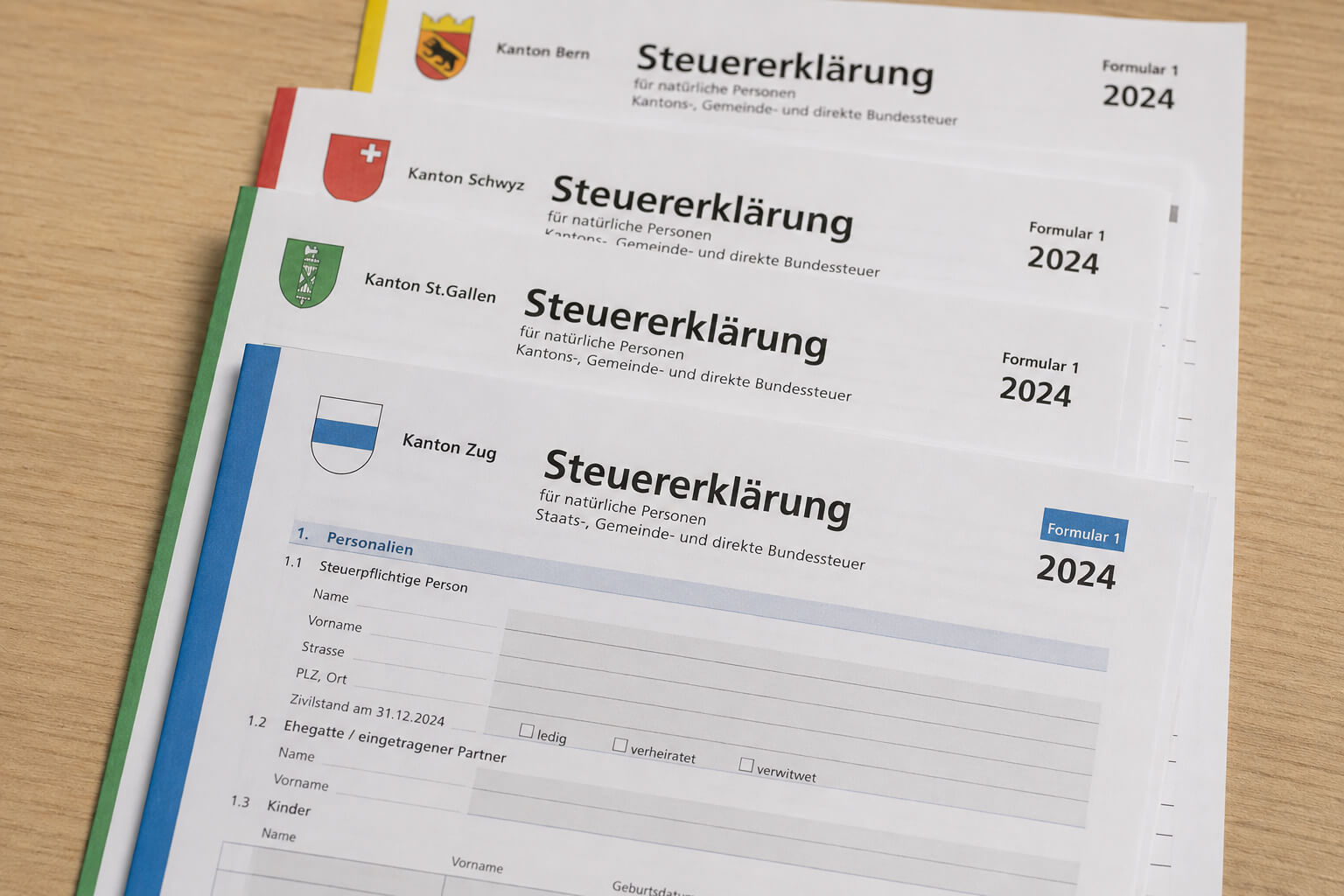
Taxed at source: how expats actually pay
Most expats never receive a tax bill in their first years: foreign employees without a C permit have income tax deducted straight from their salary.
Taxation at source (Quellensteuer, impot a la source) is not a different tax - it is the same income tax, collected monthly by your employer at a cantonal tariff that already blends the federal, cantonal, communal and, where applicable, church layers. Your rate depends on income, marital status, children, church membership and whether there is a second income in the household.
Above CHF 120,000 of annual gross income you move into mandatory ordinary assessment (NOV): withholding tax is still deducted every month, but you also file a full tax return and the difference is settled afterwards. It can go either way - a refund if you have significant deductions, a supplementary bill if you live in a high-tax commune. Importantly, once you are in the regime you keep filing in subsequent years, even if your income later falls back below the threshold (Kanton Zurich).
Below CHF 120,000 you can request ordinary assessment, by 31 March of the following year. This is usually worthwhile if you have pillar 3a contributions, pension-fund buy-ins, childcare costs or a long commute, because the source tariff only assumes standard flat-rate deductions. The catch: the request is irrevocable - it binds you for future years too. Model it before you send it.
Deadlines, correction requests for wrongly applied tariffs and the paperwork are set out in our withholding tax guide.
The deductions that matter (2025/26 federal)
A handful of deductions do most of the work, and pillar 3a is the one nearly every employed expat should be using.
- Pillar 3a: CHF 7,258 a year if you are in a pension fund, or CHF 36,288 for the self-employed without one - deducted directly from taxable income (ESTV/UBS, 2025/26).
- Commuting: capped at CHF 3,300 a year for federal tax.
- Childcare: up to CHF 25,800 per child in third-party care costs.
- Insurance premiums: CHF 1,800 for a single person, CHF 3,700 for a married couple, plus CHF 700 per child.
- Meals away from home: CHF 15 a day, maximum CHF 3,200 a year.
- Other professional costs: a flat 3% of net salary, minimum CHF 2,000, maximum CHF 4,000.
- Pension-fund buy-ins: fully deductible in the year you pay them.
These are the federal amounts. Every canton sets its own figures, and some are considerably more generous - Zurich's childcare deduction and Geneva's insurance deduction, for example, do not match the federal caps. Your cantonal return will apply the cantonal numbers automatically; the practical point is that a deduction that looks small federally may be worth more locally.
Two of these are levers rather than paperwork. Pillar 3a and pension buy-ins reduce taxable income franc for franc, which for a higher earner in a mid-tax commune means roughly a quarter to a third of the amount comes back. Our tax optimisation guide works through the sequencing.
Wealth tax - and what is not taxed
Switzerland taxes what you own each year, but not what your investments gain - private capital gains on shares and ETFs are tax-free.
Every canton levies an annual wealth tax on your worldwide net assets: bank accounts, securities, property values and vehicles, less debts. Rates are low but not trivial, running roughly 0.05% to 1% depending on canton and wealth band, with tax-free allowances - around CHF 80,000 for a single person in Zurich, for example. There is no federal wealth tax.
The counterpart is a genuine advantage. For an ordinary private investor, capital gains on privately held shares, funds and ETFs are not taxed (PwC). Dividends and interest are taxable as income, and Swiss dividends carry 35% withholding tax that you reclaim through your tax return - but the growth itself is not taxed on sale. For a long-term buy-and-hold investor that is one of the most valuable features of the Swiss system.
One caveat: trade very actively, use leverage, or make securities trading look like a business and the tax authority can reclassify you as a professional securities dealer, at which point gains become taxable income. Ordinary periodic investing does not come close to that line - see our ETF investing guide.

Deadlines and how it's billed
Most cantons want the return by 31 March of the following year, and extensions are usually easy, online and free.
The standard filing deadline in most cantons is around 31 March for the previous tax year. Extensions can normally be requested online in a couple of minutes, frequently at no cost, and are commonly granted into the summer or autumn. Missing the deadline without an extension leads to reminders, fees and eventually an assessment at the authority's discretion - which is rarely in your favour.
Billing does not wait for the return. Cantons issue provisional invoices during the tax year, based on your previous assessment or your own estimate, and reconcile once the final assessment is issued. Direct federal tax is due provisionally on 31 March of the following year. Late payments attract interest of 4.0% in 2026 (ESTV/PwC), and several cantons pay a small credit interest if you overpay early - worth checking locally.
If this is your first Swiss return, work through the ordinary assessment guide and use our Swiss tax return checklist to collect the documents before you start.
How to pay less, legally
Five moves cover almost all of the legitimate savings available to an employed expat.
- Max out pillar 3a every year. CHF 7,258 deducted from taxable income, with a payment before 31 December - pillar 3a explained.
- Use pension buy-ins in high-income years. Fully deductible and most valuable when your marginal rate peaks - see the 2nd pillar.
- Claim childcare, commuting and further education. Routinely forgotten and often worth thousands - tax optimisation.
- If taxed at source, model NOV before you request it. It is irreversible and binds future years - withholding tax.
- Choose canton and commune deliberately. When you can pick where to live, it is the single biggest lever available to you - larger than every deduction combined.
Common questions about Swiss tax
How much income tax will I pay in Switzerland?
Which canton has the lowest taxes?
Do I pay tax if I'm taxed at source?
What can I deduct?
Is there capital gains tax in Switzerland?
When is the Swiss tax return due?
Sources
- ESTV - Rundschreiben Ausgleich der Folgen der kalten Progression 2025/26
- ESTV - official Swiss tax calculator
- BAK Economics - Zurcher Steuerbelastungsmonitor 2025
- Kanton Zurich - subsequent ordinary assessment (NOV) and withholding-tax correction
- ESTV - deductions, rates and tariffs for direct federal tax
- UBS - maximum pillar 3a contribution
- PwC Worldwide Tax Summaries - Switzerland, individual other taxes
Figures marked indicative are estimates and are not formal tax or investment advice.
Want to know what you would actually pay?
30 minutes with an independent Hello Expats advisor - no obligation, no fees.